Wisdom and Wanting What's Good
Collective wisdom for a time of crisis and renewal
Collective wisdom for a time of crisis and renewal
By Rufus Pollock & Rosie Bell (Life Itself Sensemaking Studio). Seeds of Renaissance No. 6. About this paper · Download the PDF
Summary
Modernity has staged a heist: the field of legitimate knowledge has been stripped of all that’s good and beautiful, leaving only what can be measured. No wonder we’ve forgotten to trust our inner compass – what use is wisdom when the only admissible civic choices concern how much and how many? Neglected and under-cultivated, our innate faculty of wisdom is weak, but it isn’t extinct. Our future depends on reviving it.
Against a backdrop of global crisis, wisdom emerges as a vital capacity for a regenerative future. Wisdom can be framed as a capacity for choosing what’s good and acting skilfully towards it. A core foundation is the discernment of extra-rational, unmeasurable value.
Modern systems, shaped by reductive materialism, have neglected value and dulled the inner compass that knows (and co-creates) it, with consequences all the more catastrophic given our technological power to harm what is most precious in the living world.
Closing this potentially deadly ‘wisdom gap’ depends on reintegrating intuitive capacities with other powerful ways of knowing, and empowering decisionmakers through wisdom-preserving practices.
Annotated contents
- Introduction
- 1. Decision-making the modern way: questions of quantity
- (Post-)modernity ♡s measurement — Modern industrialised societies have come to privilege quantitative knowledge, marginalising values like beauty and goodness which are seen as “subjective”. This reductive approach shapes everything from public policy to education, distorting our shared sense of what truly matters. The resulting crises demand a reintegration of qualitative judgement and broader ways of knowing.
- GDP and financial proxies for happiness — Government fixated on Gross Domestic Product exemplifies modern reduction of value to measurement - neglecting essential aspects of the public good.
- Scapegoating money: the rise of extrinsic values — Money itself isn’t the problem. But our distorted relationship to it - valuing symbols over substance and chasing desires shaped by market forces - is corrosive. The increasing dominance of extrinsic values like wealth and status suppresses intrinsic values such as compassion, along with our capacity to discern them.
- 2. Knowing beyond measurement: wisdom's intuitive dimension
- Extra-rational choosing: hiding in plain sight — Restoring wisdom may depend less upon learning something new, than upon reviving a dormant human faculty for sensing what truly matters. Modern culture has sidelined our important extra-rational capacities. To restore them, we need to grant dignity and reality to valueception; breaking cultural taboos that dismiss it, and designing civic environments that reconnect people with intrinsic value. Ultimately, cultivating fluency in value is less a science than an art - ancient, embodied, and always available, if we make space and trust for it to grow.
- Case study: the work of Christopher Alexander — The ‘timeless way’ of Architect Christopher Alexander is a theory of design that embodies decision-making beyond measurement. Alexander argued that beauty and goodness in design are real, discernible qualities - not mere subjective preferences - rooted in a timeless, life-giving pattern.
- 3. Cultivating civic wisdom: experiential factors — Wise decision-making is cultivated through lived experience in a collective setting, and attunement to an embodied ‘inner compass’ shaped in part by that experience. Experience matters as much to valueception as to more analytic choice-weighting. Intuitive knowing is fallible and must be refined through practice and reflection.
- 4. Who's wise and how do we know? Self-selecting networks — Society’s wisdom is collective and contextual, rather than belonging to a central authority - but still we require ways to coordinate our decisionmaking. How do we empower the wise to guide collective decisions? Looking to precedent from law to spirituality, peer-selected networks offer a model - albeit imperfect and vulnerable to corruption. To maintain integrity, society must invest in cultivating wisdom broadly, enabling citizens to recognise and support genuinely wise decision-makers.
- Conclusion
- Further reading
- Bibliography
Preface
This paper forms part of a Second Renaissance series inquiring into our present moment of civilizational crisis and renewal – a time of grave challenge but which may also offer opportunities for a profound transformation. The series explores how shifts in foundational views and values might come to support a more wholesome, regenerative future society.
Central to this inquiry is the concept of wisdom. Often mentioned in talk of societal change but seldom defined, wisdom seems to encompass both ancient human faculties and vital collective competences for a better future.
This first of two papers explores wisdom as a cultural capacity, meaning in particular the ability to choose what’s good for us collectively, and act effectively together to make it happen. Such pragmatic discernment rests not on reason alone, we’ll argue, but on renewed sensitivity to dimensions of value and meaning that can’t be reduced to matter or measurement.
This enquiry into wisdom serves two complementary intentions. First, an open-ended response to the perennial political question: what should we do, and how should we do it? As an orienting quality of a longed-for, regenerative society, wisdom offers a better compass than modern optimisation. Second, by imagining how wisdom might really operate within civic processes and collective life, we give form to abstract aspirations for civilizational ‘renewal’, building a more substantial vision of a wholesome future culture.
Introduction
When imagining the cultural foundations of a healthier future, naturally the idea of ‘wisdom’ comes to mind.1 But the meaning of this word is elusive. Wisdom means many things to many people - from a generalised ‘folk’ sense of shrewd or intuitive knowing, to a vast array of traditions and practices designed and evolved towards living a good life, promoting healing and wholeness, and/or paring away delusion to reveal some deeper, more fundamental truth.
Our intention here is not to audit or synthesize these many wisdoms - or indeed to address the growing empirical field of wisdom research.2 Nor is it our first concern to understand wisdom as a psychological quality of individuals. We aren’t seeking a single or complete definition of wisdom. Rather, against a backdrop of declining modernity, we mean to explore:
- Wisdom as a collective tendency - showing up (or not) in good decision-making at the level of societies. 3 4
- Its relationship with deep-seated societal views associated with the current dominant cultural paradigm(s).
Thus without denying its interior dimensions, we sketch a functional account of societal wisdom as it interrelates with axioms of modernity and post-modernity; and with a hopeful vision of what might come next.5
The wisdom that orients collective action
From antiquity to the present day, wisdom has been seen as both an inner capacity and an ‘applied’ quality within collective life. Leaving aside the individual for now, we might sum up its collective meaning with the phrase ‘a wise society is one that makes good decisions that work out well for its people.’6 In the simplest terms then, the wisdom we’re most interested in here - as an aspect of desirable cultural transition - is the ability to make wholesome choices as a society – and enact them effectively.
Addressing the wisdom gap
Amid the decline of modern industrialised society, we are obliged to trace the shape of wisdom in negative space. Manifold crises, the threat of systemic collapse, and a general inability to change direction suggest a profound lack of collective capacity to choose action for the greater good. At the same time, with societal complexity escalating faster than our capacity to manage it, our technologically enabled power to inflict catastrophic harm upon ourselves, each other and our world likewise continues to grow - a disconnect known as ‘the wisdom gap.’7

Fig 1: The Wisdom Gap. A rapidly growing gap between society’s technological and social complexity and our "wisdom" i.e. our capacity to manage that complexity well.8
It’s uncontroversial to associate wisdom with rational understanding - with the capacity to grasp what’s going on in a given context, and apply knowledge and analysis to interpret events and guide action. The complexity of our times plainly overwhelms understanding, and it’s tempting to suggest that this shortfall alone explains our ‘wisdom gap’. Still, most would intuitively agree that there’s more to wisdom than analytical skill.
This essay imagines wisdom as a composite capacity formed of at least three interwoven dimensions. The first, valueception, is a capacity to sense and respond to what is good or worthwhile.9 The second, call it sensemaking, is a capacity to understand how things are and how they work, and so to discern skilful ways of moving towards the good. The third is will – in the everyday sense of political will or good will: the capacity, individual and collective, to act on what we've discerned. Each can draw on rational analysis, but each also relies on intuitive, embodied discernment operating beneath or beyond it.
There is a natural order to them: we must sense what is good before we can work out how to reach it, and discern before we can act. But this is a rough order of dependence, not a strict sequence: in practice the three run together as a single living process, as what we value shapes what we notice and acting reveals truths we would not have foreseen. And knowing what's good counts for little without the resolve to pursue it.10
Of these three dimensions, we explore valueception in greater depth in this essay as it is this dimension of wisdom that has become especially alienated, even suspect within modern choice-making, and its neglect is increasingly corrosive.11 A growing body of contemporary thought aims to revive and refine the concept - an innate, intuitive relationship with value, no less trustworthy for operating beyond instrumental logic.12

Fig 2: Three dimensions of wisdom. Valueception (sensing what's good), sensemaking (discerning paths towards the good) and will (the resolve to act), whether exercised individually or collectively. Each marker shows its dimension as one layer of a single whole, with valueception at the core. The order is one of dependence, not a strict sequence: in practice the three work together.
More an embodied skill than an esoteric gift, valueception has been steadily eroded by a reductive cultural system that privileges abstraction over lived and felt experience; gradually undermining the tendency to create or preserve what really matters. At the level of globalised society, we have forgotten how to want what’s good.13
Integrating ways of knowing
Diminishing and even denying intuitive skills like valueception, modern societies have come to prioritise two other processes for directing choice: rationality, understood as logical derivation of outcomes, and empiricism which seeks ‘objective facts’ about the world of things, through material evidence and typically via measurement.
Without setting out to vilify these useful ways of knowing, this essay explores what is lost through modern over-reliance upon them. It introduces some thinkers who insist that the intuitive capacities that know beauty or wholesomeness are just as important to a functioning and flourishing society.
Taking for granted the already-legitimate forms of rational sensemaking and intelligence that play a part in wise collective choices,14 we advocate a rehabilitated respect for ‘wisdom’ as a missing pillar of collective choice-making.15 Not an alternative to measurement or logic, but a broader capacity that that integrates both with skilful, embodied discernment of subtler value.16
We should make clear that, while we discuss wisdom as a possible foundation of a future cultural paradigm, we don’t mean to suggest that it is something new. Countless ancient traditions hold insight into the nature of wisdom and its cultivation - from indigenous cultures to religious traditions and beyond. A wiser future society might recognise the respect due to such traditions - but guard against looking to them for ready-made answers. Wisdom arises in context, and all societies urgently need an applied sense of situational wisdom for today’s (and tomorrow’s) world. At the same time we may hope that a renewed commitment to wisdom helps reawaken a way of seeing that transcends any given human context - our survival depends on it.
“I don't believe Indigenous knowledges can give us the instructions of how to swim in our world… the particular flood that we're going to have to face. But they can remind us that it's possible to swim.”
- Vanessa Andreotti17
1. Decision-making the modern way: questions of quantity
*“The meta-crisis is a profound misunderstanding of the nature of what is valuable…pursuing an abstract definition of value, quantitative, financialised… to the detriment of the actual, living field of embodied, intrinsic value.” –*Zak Stein18
(Post-)modernity ♡s measurement
Modern industrialised societies have come to privilege quantitative knowledge, marginalising values like beauty and goodness which are seen as “subjective”. This reductive approach shapes everything from public policy to education, distorting our shared sense of what truly matters. The resulting crises demand a reintegration of qualitative judgement and broader ways of knowing.
In large societies, decision-making - what we cultivate and restrict, award and punish - is co-ordinated by powerful institutions. Built into these institutions are particular value judgements, often arising from a deeper cultural worldview: a set of foundational assumptions about reality, including what counts as valid knowledge. 19 20 Modern industrialised cultures tend to privilege empirical knowledge, based in observation, evidence and measurement, and rational knowledge, based in logical analysis and calculation. Together, these approaches influence what we accept as fact, and how we organise facts into legitimate decisions.
Modern scientific method and capitalist economics have been profoundly effective; unlocking extraordinary technological advances, transforming everyday comfort for many, and concentrating power within particular sectors of modern society. Over time, however, measurement and calculation have together come to seem like goods in themselves - what can’t be easily quantified is often marginalised or dismissed as illegitimate; even suspect. Thus the question of what we value is dominated and distorted by how value is determined: the public good we seek falls within the confines of what is measured.21
As Dougald Hine points out, modern tendencies to outsource judgment to processes of measurement and calculation have some pro-social origins. For example, the European quest to root authority in universal material certainty was in part a response to the horror of the Thirty Years’ War - an early modern experience of devastating conflict, stemming from theological disputes.22 23
“…the tendency within modern societies to ask science to do the work of politics – the desire to replace the frail and fallible exercise of judgement with processes of measurement and calculation”
Nonetheless, scientific and industrial successes helped persuade modern society that measurable qualities were more real, and more worthy of attention than ‘subjective’ values such as beauty and meaning. In turn, the priorities of industrial society drew legitimacy from a collective idea of ultimate, objective truth; further cementing this hierarchy.
Value relativism
While modern thought and culture was often content to leave inherited, non-quantitative values intact and unexamined, post-modern scepticism finished the job; stripping them of any claim to reality beyond the beholder.24 Throughout the last century, ideas like goodness and beauty have been increasingly relegated to the realm of pure relativism, and the weight of all our collective decision-making has fallen - officially at least - upon logical and empirical ways of knowing.25
The relativist critique has noble intent - and in the last century in particular, has helped dismantle the tyranny of certain socially constructed value systems. However, in partnership with reductive materialism, the moral disqualification of non-material value has contributed to a great deal of harm.
“A subtle, inarticulate, and pernicious nihilism is pervasive, wherein values are seen, at best, only as social constructions - or worse, as subtle ploys for power.”
- Temple (2023)
Institutional values
This narrowing of the field of legitimate value is encoded in dominant institutions of late modernity, producing governance that often overlooks a lot of what really matters. A market-fundamentalist economy, assuming that the consumer is perfectly rational and choosing in their own best interest, treats price signals as a reliable guide to the collective good.26 Rationalist bureaucracies formalise decision-making, often substituting systems of calculation and scientific conclusions for human discernment.27 Choices are overwhelmingly quantity-led, whether in business or in public services. Q: How should we use our resource? A: Whatever generates the highest numerical value of output per unit of input. Unsurprisingly, leaving ‘the market’ to make our biggest decisions for us has proved a fatally inadequate way to preserve value within our living world. A system that reduces the principal value of a forest to the price of a stretch of land or a weight of timber fails utterly to comprehend real value and is destined to destroy it.
Learning how much
Modern education systems are likewise geared towards cultivating knowledge with a quantitative bent. Thanks in part to the demands of an entrenched culture of assessment, we ‘treasure what we measure’, and teach our children to do the same, prizing STEM subjects and deprioritising arts. In fact, this reductivism is proving inadequate even in those professional areas that appear superficially to be matters of measurement. For example, the engineering sector has begun to sound alarm bells about hyper-emphasis on STEM curricula producing cohorts of engineers without the necessary ability to integrate different forms of knowledge in solving real-world problems. Many engineering faculties now call for emphasis on subjects that habituate critical, holistic and complex thinking, and creative judgement.28
GDP and financial proxies for happiness
“ The money machine… eats quality and shits out quantity.” ― William S. Burroughs
Government fixated on Gross Domestic Product exemplifies modern reduction of value to measurement - neglecting essential aspects of the public good. Money itself isn’t the problem. But our distorted relationship to it - valuing symbols over substance and chasing desires shaped by market forces - is corrosive. The increasing dominance of extrinsic values like wealth and status suppresses intrinsic values such as compassion, along with our capacity to discern them.
Another familiar exemplar of modernity’s assessment of value is Gross Domestic Product (GDP). Q: What do we want our leaders to deliver? A: The highest possible financial valuation of all goods and services produced and rendered in a specific period. GDP is the common yardstick of success in modern government; in industrialised societies we typically empower leaders who convince us that they can protect or grow it.
GDP rightly attracts widespread criticism as a measure of societal success - and indeed, it was not originally intended to be used this way.29 Even within a basic, utilitarian frame, it falls well short of its function as a proxy for the public good.30 Inequality aside, it may provide a very loose indication of important factors like resources available for healthcare or household income. But this most reductive of value systems leaves vast, unmeasurable areas of citizens’ wellbeing unaccounted for. What about people’s need for beauty? Joy? Sacredness? The strength of their social bonds or connection to nature? Critics of GDP point out that society’s ills stem in large part from neglecting the unmeasurable good.31
Scapegoating money: the rise of extrinsic values
Arguably, while it receives a bad rap, money itself isn’t the problem. Fundamentally, money is just a token that we use to approximate value so that we can exchange our resources - time, effort, energy - for other things that we need and want. Large societies will always need a standardised system of exchange. Capitalism - and more recently, Neoliberalism - complicated this relationship by by elevating wealth generation into a value in its own right; ensuring that those getting paid the most are never those creating the most genuine value for society. However, our problem is not only that we have learned to value the token over the thing itself, but that at a planetary scale, what we want to buy tends increasingly to be toxic.
In the modern world, besieged by influencers, advertising and algorithms, we’re increasingly bad at wanting what’s good for us. Sure, we like trees, and art, and dancing, and sunshine and fresh air, but often we prefer (or are persuaded) to spend our money on fast fashion, large cars, getting ripped, and flights to prestige destinations for instagram-documented holidays*.* These days when we critique money, often we’re proxy-critiquing humanity’s susceptibility to market manipulation and dopamine hijack, and our growing blindness to ‘intrinsic’ value.32 This effect may be due at least in part to a vicious circle - the less we are habituated to valuing intangible or measureless virtues, like compassion or wonder, the less salient they become, dulling our capacity to sense them.
This dynamic aligns with a robust finding in values research: ‘extrinsic’ values like wealth, image, and status, mutually inhibit ‘intrinsic’ values, like empathy, community, and environmental concern. As such, the systematic promotion of extrinsic values within capitalist systems produces a decline in intrinsic motivation and concern for the common good over time.33 Studies show that as cultural emphasis shifts towards materialism and image-enhancement, collective wellbeing suffers - fuelling anxiety, disconnection, and ecological neglect.34 The societal dominance of extrinsic values both distracts us from what matters most, and gradually undermines our capacity to even perceive it.
2. Knowing beyond measurement: wisdom’s intuitive dimension
Restoring wisdom may depend less upon learning something new, than upon reviving a dormant human faculty for sensing what truly matters.
Modern culture has sidelined our important extra-rational capacities. To restore them, we need to grant dignity and reality to valueception; breaking cultural taboos that dismiss it, and designing civic environments that reconnect people with intrinsic value.
Ultimately, cultivating fluency in value is less a science than an art - ancient, embodied, and always available, if we make space and trust for it to grow.
Late (post-)modern failures of collective discernment form a vicious circle. At the institutional level, an inadequate, inhumane account of the public good. At the cultural and personal level, a generalised difficulty in recognising (and choosing) wholesome value both among citizens and leaders. Together, these shortcomings - amplified by market manipulation - help maintain a rapacious consumer society, destroying what is authentically valuable, from social trust to living ecosystems, with ever growing speed and power.
We have arrived at the wisdom gap; where accelerating technology rushes ahead of faltering sensemaking. Beyond this precipice, modern thinking seems unable to avoid making our crises worse. So what kind of knowing could help guide a much needed renaissance; towards a future society capable of perceiving and choosing qualities that allow it to flourish?
Extra-rational choosing: hiding in plain sight
“Wisdom is what remains when we come to the end of everything we know”
- Bayo Akomolafe
“What is valuable seems to be immediately felt and cognized.”
- Iain McGilchrist
A modern instinct might look for the next tool or invention to correct our course. But innovation bias is a driver of the wisdom gap, not an antidote. What we need may be something we already have: an existing capacity we have forgotten to trust. After all, humanity would not have flourished without any innate means of being in touch with what is true or good.35 Formal reasoning and science are recent additions to our repertoire - long before their arrival, there were things we knew, and ways we knew them.
Indeed, while modern decision-making reserves legitimacy for evidence gathering and reason, in practice these faculties always operate in collaboration with more subtle or intuitive kinds of judgement.36 37 Similarly, together with reason, our ethical beliefs and behaviours are influenced by powerful intuitive and emotional complexes such as compassion, anger and empathy. Though treated by modern institutions as unreliable at best - at worst, unserious, oppressive, and even malevolent - these powerful, extra-rational motivations have not been extinguished. But socially conditioned denial has left repressed qualities unaccounted for, within an impoverished understanding of human motivation and behaviour. For example, modern political economy rests on the assumption of consumer decision making as fully rational and conducive to the human good.38 Meanwhile at a mass level, extra-rational motivations direct behaviour unacknowledged, unchecked, and moreover uncultivated.39
These impulses transmit both noise and sense: outdated evolutionary drives that need awareness to be managed, and deeply meaningful signals that need attunement to be heard.40 They connect us to a field of value and values that can only be known phenomenologically - that is, through our subjectively mediated, felt sense.41
Salience, credibility and cultivation: restoring virtuous cycles
A wiser vision of the social good must welcome back the extra-rational faculty and restore it to health. This way of knowing can only be revived through use - and therefore by granting what it knows the dignity of being both real and important. We need to invest in our relationship with value - believing in it, and infusing life with it where possible. Like wisdom, value resists definition. We don’t want to fall into the modern trap of seeking to understand in a narrow sense or enclose wisdom by defining it. However, this should not prevent us from attuning to an ineffable sense of value, and navigating by what we find.
As discussed above, a tendency to promote extrinsic values in capitalist societies has led to lifestyles and environments depleted of measureless value; reducing its salience, dulling desire and hastening its destruction in a vicious circle. Furthermore, nothing inhibits perception like lack of belief 42 - or worse, cultural norms that shame those who do believe. Accordingly, wherever a post-modern emotional regime casts the idea of ‘real’ value as oppressive, valueception isn’t getting enough exercise.43
From a cultural perspective, reawakening this faculty may require some kind of amnesty - a way of lifting the unspoken institutional taboo on real value, at least far enough to admit different priorities in shared decision-making. This might be easier than it sounds. After all, we go around treating things like beauty as if they matter every day - we just don’t publicly agree that they do. But what if we did? A pragmatic approach might begin with civic choices that disrupt vicious cycles of extrinsic value by reconnecting citizens with intrinsic value in daily experience - from nature connection to wholesome built environments.44
Above all, the cultivation of fluency in value is an art, not a science. Note, not some new, pseudo-practice somewhat like art, but art itself - and as such ancient, alive, innate, and eminently available to us; requiring reprioritisation, space and some faith to thrive, even in the harshest circumstances.
Case Study: the work of Christopher Alexander
The ‘timeless way’ of Architect Christopher Alexander is a theory of design that embodies decision-making beyond measurement. Alexander argued that beauty and goodness in design are real, discernible qualities - not mere subjective preferences - rooted in a timeless, life-giving pattern.
Recall that we don’t mean to supplant reason as a way of making choices - rather to integrate our ways of knowing towards a flourishing (let’s say) transrational capacity. One visionary modern figure pioneered just such an approach, demonstrating how deeper forms of value might be recognised within contemporary civic decision-making.45
The life’s work of the architect Christopher Alexander embodied a profound commitment to real value, and ways of discerning and developing it concretely in the world. A major figure in post-WWII architecture and a fierce champion of human-centered design, Harvard-trained Alexander might be considered an unsung meta-modern pioneer operating in a post-modern environment. Among contemporaries influenced by modern abstraction and post-moder value relativism, Alexander rebelled, asserting that the good and the beautiful in architecture throughout history are not simply matters of opinion but objectively real, expressed through manifold forms and cultures throughout time:
“There is one timeless way of building. It is thousands of years old, and the same today as it has always been. The great traditional buildings of the past, the villages and tents and temples in which man and woman feels at home have always been made by people who were very close to the center of this way. It is not possible to make great buildings or great towns, beautiful places, places where you feel yourself, places where you feel alive, except by following this way… this way will lead anyone who looks for it to buildings which are themselves as ancient in their form as the trees and hills, and as our faces are.”46
For Alexander, the ‘timeless way’ of designing buildings that seem to be alive, whole47, comfortable, free, exact, egoless, and eternal rests on a nameless quality that is ‘objective and precise, but which cannot be named.’ (Appendix III gives Alexander’s own words, and his account of the assumptions that hide it.) Each building expresses the quality differently; materially manifest, but never reducible to fixed material properties - Alexander lists both tents and temples as possessing this quality. 48
Alexander was writing and designing during a period in which postmodern scepticism overshadowed the “common-sense sacred axioms”49 that underpinned a cultural commitment to beauty in earlier modern times. As shared intuitions about the good fell into doubt, architecture was among many fields left with a reduced account of real value. Over time, architectural theory became “functionalised” and reduced to technical rules, treating aesthetic judgement as merely subjective.50 Contemporary regulatory frameworks reflect this same shift: overwhelmingly quantitative, focused on structural and functional metrics, with even relationship with nature reduced to spatial indices such as square metres of green space.
While many of these measurable standards are essential to a functioning society - how strong are our buildings; how safe and durable? How well ventilated, efficiently heated and sanitary… they exclude subtler, deeply consequential aspects of human experience. How do the buildings we inhabit tend to shape our inner world, at the scale of lifetimes? To what extent do they invite community?
Many architects today are guided by a commitment to humane and life-giving spaces. However, this sense of the good rarely arrives intact at the place where civic decision-making meets the built environment. In principle, policy should function to carry design vision and an understanding of wholesome functionality into decisions on the ground. But policy must be expressed in evidence-based terms, with many values erased the moment they are rendered measurable. At the level of implementation, value is further abstracted by developers; financially driven and adept at building to the letter but not the spirit of the law.51 The result is a funnel - rich architectural intuition tightening into bureaucratic metrics, then again into cost-driven implementation; squeezing value out of the equation.
As a consequence we typically enforce, down to the metre, how far a building must sit from the pavement, but risk ignoring whether the people who use it as a place of work are likely to find it wholesome or beautiful – and be kinder to each other as a result. Without attention to such qualities, Alexander asserts, consequences for the built environment and on human life have been injurious:
“We've been taught that there is no objective difference between good buildings and bad, good towns and bad. The fact is that the difference between a good building and a bad building, between a good town and a bad town is an objective matter. It is the difference between health and sickness, wholeness and dividedness, self maintenance and self-destruction. In a world which is healthy, whole, alive, and self-maintaining people themselves can be alive and self-creating. In a world which is unwhole and self-destroying, People cannot be alive, they will inevitably themselves be self-destroying, and miserable.”
Alexander’s work gives reality to beauty as patterns of relationship with a particular coherence, recognised through concrete forms, places and experiences. Thus A Pattern Language (1977) explicitly lays out a flexible “grammar” of spatial solutions.52 Temple’s (2023) idea of a “universal grammar of value” offers a similar account, treating value as shared, but expressed differently in different contexts. More formula than form.53
From the point of view of post-modern scepticism, the ‘timeless quality’ thesis may still be difficult to accept. However, for the purposes of consciously imagining a future society, whether such a pattern is perfectly ‘real’ doesn’t entirely matter. In wondering whether it is, we risk getting drawn back into an abstract, modern way of looking. In the service of loosening old mindsets, and prioritising experience over the abstract, we might begin simply by behaving as if this quality or value were (somewhat) real, and observing what happens when we do.54 Alexander himself advocated this approach; preferring design to emerge from real human needs, and prove itself through use.55 In the passage above, he identifies the timeless quality by its consequences - a built environment that’s observably healthy, rather than poor.56
The timeless quality in practice
Alexander intends nothing less than to suggest a “complete working alternative to our present ideas about architecture, building and planning.” His book The Process of Creating Life, features a case study - an actual house built in Berkeley in the 1990s - that exemplifies the “living process” of designing-while-building. In contrast to modern abstract planning, this experience-led, generative process is based on respect for ‘unfolding wholeness’, through a sequence of ‘structure-preserving transformations’. This quality of wholeness is co-created in real time, a participatory interaction between the architect(s) and the evolving built space, led by lived experience and observation. This is not a quaint suggestion of built structures that emulate the appearance of natural objects, but rather a radical view of building as nature; as life - interdependent with humans and human creation, and subject to universal creative principles.
Adopting such a template for building would mean codifying a particular sequence of participatory, experiential steps - rather than prescribing a measurable outcome. Its scalability is unproven - however its tendency to produce wholesome and harmonious buildings is supported by Alexander’s output.
On Alexander’s view, for society to become well, we must set our sights on a visionary future, with a renewed view of structure that sees living process as the origin of all life.57 Importantly, such a process does not reject reason or measurement, but includes and transcends these important dimensions of modern decision-making.
| Institutional mode | The timeless way | |
|---|---|---|
| What matters? | Measurable, functional, compliant, tangible | Alive, whole, comfortable, beautiful, fitting |
| How do we know? | Metrics, plans, regulation, abstract expertise | Embodied experience, local knowledge, felt coherence |
| How do we make it? | Bureaucratic process, formal approval, abstract, fixed design | Living process, iteration, unfolding, structure-preserving transformations |
| Who shapes it? | Developers, officials, surveyors, consultants | Residents, communities and practitioners working together |
| What do we get? | A technically complete object | A place that belongs, endures and feels alive |
3. Cultivating civic wisdom: experiential factors
Wise decision-making is cultivated through lived experience in a collective setting, and attunement to an embodied ‘inner compass’ shaped in part by that experience. Experience matters as much to valueception as to more analytic choice-weighting. Intuitive knowing is fallible and must be refined through practice and reflection.
An essay of this scope wouldn’t presume to define wisdom for all people or times. Still, with the help of Alexander and others, we’re beginning to sketch a pragmatic outline of the wisdom that we’re lacking now - a capacity for sensing or co-creating trans-rational value and weaving it into choices that serve the greater good. If we’re agreed that this sounds like a desirable ingredient in a healthier future society, the question then becomes: how can we cultivate it, and what conditions does it require?
Contextualised practice and experience
Wisdom discourse broadly agrees on the applied nature of wisdom - its function is to guide action, and wise action is context-specific. A society is wise in a collective context; given to making choices for the good of the group. To enable us to weigh complex choices, to integrate diverse needs, to discern what’s good with a long-term view, wisdom must arise from lived experience within the group in question, and of consequential choices made therein.58 59
Folk and academic accounts of wisdom alike link wisdom with age and experience. This perennial association can be interpreted in two important ways. First, like any innate capacity from walking to whistling, discernment requires attunement built by practice over time to function well. Second, the longer our experience in a particular context, the more knowledge we likely have of the outcome of wise (and unwise) choices in action.
This experiential dimension of wisdom matters as much to valueception as to more analytic choice-weighting. If we wish to avoid ‘naive intuitionism’ we should look to experience to attune our subtle senses, and never cease reflecting upon whether outcomes bear out the wisdom of our choices.60
Cultivating embodiment and attunement
Experiences of qualities such as beauty are mediated by embodied, emotional awareness. The misgivings that suggest what we might want to avoid are likewise rooted in felt sense. Some call this our inner compass61 - a subtle attunement towards what’s good; awakened by familiarity, and shaped by the kind of lived experience we have just discussed. This intimate navigation system is cultivated through connection to the body it abides in - another kind of knowledge that has suffered through modern privileging of mind over body; reason over emotion. While the routes to that cultivation are outside our scope here, it’s worth mentioning the body of work that links the idea of an inner compass to existing types of inner development and embodiment practice.62
We might furthermore suggest that the effectiveness of our inner compass is likely supported by certain conditions. For example stillness, quiet, and other factors conducive to reflection and focus - within which to ‘listen’ deeply for a subtle inner signal. We are rarely wise in a hurry or amid distraction - with clear implications for the wisdom of modern life.
4. Who’s wise and how do we know? Self-selecting networks
Society’s wisdom is collective and contextual, rather than belonging to a central authority - but still we require ways to coordinate our decisionmaking. How do we empower the wise to guide collective decisions? Looking to precedent from law to spirituality, peer-selected networks offer a model - albeit imperfect and vulnerable to corruption. To maintain integrity, society must invest in cultivating wisdom broadly, enabling citizens to recognise and support genuinely wise decision-makers.
Limiting analysis of wisdom to the personal might feel safer, and altogether less presumptuous than trying to design its role in governance. Nonetheless, if there’s one certainty in these precarious times, it’s that business-as-usual will not endure. With due humility then, anyone who aspires to a future world guided by discernment and genuine value must also start to wonder how wisdom could be integrated in (preferably democratic) decision-making.
Accounts of wisdom such as Mulgan’s emphasise its distributed nature - the applied knowledge and modes of discernment we require to choose well together arise in groups, in context. They are not the property of any single, generally wise authority. Wisdom is also native to us all. Like any other sense - a musical ear, a connoisseur’s nose - most of us are capable of cultivating it to some extent, and our societies are all the wiser if more of us do so.
Nonetheless, collective life still requires decisions to be coordinated. While societies may well develop better frameworks and even technologies for combining and applying collective knowledge, we will still depend upon the discernment of particular people in particular contexts. And some of us will cultivate wisdom more deeply than others. So how can those with greater wisdom be empowered to decide on behalf of the whole, in appropriate contexts?
We might first consult precedent. Some modern institutions still depend upon discernment beyond calculation. Consider the civil judge or magistrate, whose task is to review evidence and decide the outcome of a case. This specialist task requires human judgement - not only objectively weighing the evidence and applying analysis, but also bringing experience and intuition to bear in sensing the just course of action. Judges aren’t physicists or statisticians. The very term ‘judgement’ means more than pure logic and quantitative values.63
In an ideal world (which reality frequently fails to live up to) judges are experienced, skilful and competent law professionals. Since relevant expertise is needed to assess whether a candidate has these qualities, mass democracy is often considered unsuited to appointing them. Traditionally - in the UK at least - judges were selected for their function by groups of (theoretically) experienced, competent peers.
The judiciary isn’t the only example of a system that selects decision-makers by peer appointment, based on experience and proven capability. Consider groups of spiritual practitioners such as monasteries. Networks of expertise are trusted to make the most appropriate appointment based on discernment honed by their own practice: something a lot like wisdom. Lineage provides a container for transmission of that practice over time. Who were your teachers? Who were theirs?
Other sectors that operate on highly cultivated discernment appoint experts in a similar way. People who understand wine. Perfume. Who run conservatoires or coach athletes. How do we know they’re not just making it all up? Because theoretically, groups of similarly discerning experts can tell.
Such systems are highly imperfect, particularly in their susceptibility to corruption. For example, the process of appointing spiritual and religious leaders regularly fails to produce leaders with the necessary integrity. Likewise the judiciary - indeed, appointment within the British Judicial system has changed in recent decades to a more bureaucratic model in an effort to weaken “old boys” networks. Conversely, democratic checks and balances intended to limit corrupt appointment are likewise imperfect. We need only glance at the current state and trajectory of the American supreme court, for example, where a patina of democracy legitimises highly partisan appointments.64
Are there ways in which, awake to this risk, we might achieve appointment of wise leaders, both without corruption and whilst attending to qualities that are hard or impossible to ‘objectively’ measure? We imagine so - however their design must be a collective, iterative process. Their success will require renewed belief and fluency in value, and sincere attention to cultivating wisdom both among leaders and among the wider populace. And ultimately they will require adaptive, deliberative institutional structures, flexible and accountable enough to think long-term, and regularly correct for inevitable mistakes. As such, in creating self-validating networks of expertise, (true) wisdom begets wisdom.
Reconciling wisdom and democracy
This proposal presents questions for democracy. If appointing wise decision-makers is contingent upon a level of wisdom - if only people with deep, relevant experience are qualified to choose - how could any such system maintain public trust and legitimacy? How can wise leadership remain compatible with freedom from oppression? These too are questions for future collective sensemaking, design and iteration. However we may note that democracy in all of its ideal forms hinges upon an assumption of wisdom, and effective democracy is incompatible with ignorance. Some capacity to choose well is always required.
For example, from the mid-nineteenth century onwards, Nordic societies invested in popular education and lifelong learning movements - particularly the folk high schools - oriented towards cultivating maturity and ethical discernment. Scholars of the wider ‘Bildung’ movement observe how this long project of inner development enabled the later emergence of mass democracy.65 The cultivation of civic wisdom as an essential element of democracy reaches back much further, to ancient Greece, where philosophers saw lifelong learning, the arts, and moral formation as essential to freedom. Citizens were educated to exercise higher faculties of reason and spirit through the cultivation of virtue; the better to participate responsibly in collective life.66 When we begin to imagine a future society fully invested in cultivating wisdom as a foundational capacity, it becomes easier to intuit how wise leadership can be compatible with democratic values.
Conclusion
In a world stripped of shared foundations for knowing, fractured by disinformation and overwhelmed by complexity, the need for good collective decision-making has never been greater - nor more elusive.
This epistemic crisis forms the backdrop to our call for a revival and reintegration of wisdom - not out of ideological opposition to science and reason, a collapse into exceptionalism, or naïve nostalgia, but a desperate need for more thorough understanding of our shared reality. This subtle, enduring pillar of sensemaking both complements and transcends modern methods, critical to discerning action for the common good.
Temporarily taboo in public life, the values that wisdom deals in - depth, sacredness, interconnection - have been eclipsed by systems that privilege only what is material and can be measured. While the status of their ‘reality’ is a metaphysical question beyond the remit of this essay, it’s uncontroversial that acting as if they don’t exist has set industrialised modern society on a course for collapse.
What we need, it is within us to discern. The task ahead is not to invent wisdom anew, but to renew and reintegrate it. Wisdom runs continuously through many traditions, from indigenous cosmologies to contemplative lineages, very much alive. Our imperilled world urgently requires renewed respect towards these traditions, alongside a radical effort to cultivate and inquire into what wisdom might mean within post-modernity and beyond. Part two of this series will explore some of these questions in greater depth.
In short, a regenerative future depends upon reviving faith, both in the faculty of wisdom and the field of value it orients us toward. It may feel disquieting that no neat roadmap can be offered to guide such a shift. Nonetheless we do possess a compass, if only we can cultivate the faith and attunement to follow it.
Further reading
This essay is part of an emerging field of thought both on wisdom and especially around the ontology of value. Readers may also wish to explore:
McGilchrist, I., 2021. The Matter with Things: Our Brains, Our Delusions, and the Unmaking of the World, Volume 1. London: Perspectiva Press. Chapter 26
Alexander, C., 1979. The Timeless Way of Building. New York: Oxford University Press.
Alexander, C. (2004) The nature of order: An essay on the art of building and the nature of the universe. Book four: The luminous ground. Berkeley, CA: The Center for Environmental Structure.
Temple, D.J., 2023. A new story of value: cosmo-erotic humanism and the future of meaning. New York: The Center for World Philosophy and Religion.
Taylor, C. (2024) Cosmic connections: Poetry in the age of disenchantment. Cambridge, MA: Harvard University Press.
Bibliography
Alexander, C., Ishikawa, S. and Silverstein, M. (1977) A pattern language: towns, buildings, construction. New York: Oxford University Press.
Alexander, C., (1979). The timeless way of building. New York: Oxford University Press.
Alexander, Christopher (2002–2005) The Nature of Order: An Essay on the Art of Building and the Nature of the Universe. 4 vols. Berkeley, CA: Center for Environmental Structure
Andersen, L.R. and Björkman, T. (2017). The Nordic secret: A European story of beauty and freedom. Stockholm: Fri Tanke Förlag.
Aristotle (2009) The Nicomachean Ethics. Trans. D. Ross, rev. L. Brown. Oxford: Oxford University Press.
Assor, A., Benita, M. & Geifman, Y. (2023) The Authentic Inner Compass as an Important Motivational Experience and Structure: Antecedents and Benefits. In R. M. Ryan (ed.), The Oxford Handbook of Self-Determination Theory (pp. 362-386). Oxford: Oxford University Press.
Barbier, S., Bell, R., & Pollock, R., (2024.) Second Renaissance: A time of civilizational crisis and awakening. Life Itself. Available at: https://secondrenaissance.net/paper.
Barbier et al. (2026) ‘In Tech We Trust’. Life Itself (online) available at: https://drive.google.com/file/d/1BnlG8-AgVwSQ1vywsUzhyLzOLksRQfhb/view
Brach, T., (2003). Radical acceptance. New York: Bantam.
Bristow, J., Bell, R. and Wamsler, C., (2022). Reconnection: Meeting the climate crisis inside out. Research and policy report. The Mindfulness Initiative and LUCSUS. Available at: https://www.themindfulnessinitiative.org/reconnection
Clayton, V.P., (1976). Conceptualizing wisdom. Doctoral dissertation. University of Southern California.
Clayton, V.P., (1982). Wisdom and intelligence: The nature and function of knowledge in the later years. The International Journal of Aging and Human Development, 15(4), pp. 315–323.
Davis, Z. and Steinbock, A. (2024) ‘Max Scheler’ in Edward N. Zalta & Uri Nodelman (eds.) The Stanford Encyclopedia of Philosophy. <https://plato.stanford.edu/archives/spr2024/entries/scheler/>.
Deneen, P.J. (2018) Why Liberalism Failed. New Haven and London: Yale University Press, Chapter 5.
Dong, M., Weststrate, N.M. and Fournier, M.A., (2022). Thirty years of psychological wisdom research: What we know about the correlates of an ancient concept. Perspectives on Psychological Science, 18(4), pp. 778–811. Available at: https://doi.org/10.1177/17456916221114096.
Foucault, M. (1980) Power/Knowledge: Selected Interviews and Other Writings 1972–1977, edited by Colin Gordon, Pantheon Books
Frings, M.S., (1997). The mind of Max Scheler: The first comprehensive guide based on the complete works. Marquette: Marquette University Press.
Frings, M.S., (2001). The mind of Nicolai Hartmann. Chapter 5: “Ethics”. Milwaukee, WI: Marquette University Press.
Gendlin, E.T., (1981). Focusing. New York: Bantam.
Grossmann, I., (2017). Wisdom in context. Perspectives on Psychological Science, 12(2), pp. 233–257. doi: 10.1177/1745691616672066. Available at: https://pubmed.ncbi.nlm.nih.gov/28346113/.
Hartmann, N., (1932/2002). Ethics. Translated by S. Coit. New Brunswick, NJ: Transaction Publishers.
Hine, D., (2023). At Work in the Ruins: Finding our place in the time of climate crises and other emergencies. Chelsea Green Publishing
Hine, D. (2024) ‘The gifts in the ruins’, Writing Home, 26 August. Available at: https://dougald.substack.com/p/the-gifts-in-the-ruins
Holmes, T., Blackmore, E., Hawkins, R. and Wakeford, T., (2011). The Common Cause Handbook. Machynlleth, Wales: Public Interest Research Centre.
Institute for Policy Dialogue, n.d. GDP is the wrong tool for measuring what matters. Available at: https://ipdcolumbia.org/publication/gdp-is-the-wrong-tool-for-measuring-what-matters/.
James, W., (1907). Pragmatism: A new name for some old ways of thinking. New York: Longmans, Green and Co.
Jeste, D.V. et al., (2019). The new science of practical wisdom. Perspectives in Biology and Medicine, 62(2), pp. 216–236.
Kabat-Zinn, J., (1994). Wherever you go, there you are. New York: Hyperion.
Kahneman, D., (2011). Thinking, fast and slow. London: Allen Lane.
Kahneman, D. and Tversky, A., (1979). Prospect theory: An analysis of decision under risk. Econometrica, 47(2), pp. 263–291. Available at: https://www.jstor.org/stable/1914185.
Kasser, T., (2002). The high price of materialism. Cambridge, MA: MIT Press.
Kripal, J.J. (2019). The Flip: Epiphanies of Mind and the Future of Knowledge. Bellevue Literary Press.
Krishnamurti, J., (1974). Relationship is the foundation of existence. Available at: https://www.youtube.com/watch?v=ODyCN7-zLGY.
Lancaster, T. (2025) ‘The architecture of life: Christopher Alexander and the hidden patterns of beauty’, Kingston upon Thames Society, 28 May. Available at: https://kts.org.uk/the-architecture-of-life-christopher-alexander-and-the-hidden-patterns-of-beauty/
Levine, P.A., (2010). In an unspoken voice: How the body releases trauma and restores goodness. Berkeley, CA: North Atlantic Books.
Machado de Oliveira, V., (2021). Hospicing modernity: Facing humanity's wrongs and the implications for social activism. Berkeley, CA: North Atlantic Books.
Machado de Oliveira, V., (2024). Hospicing modernity and rehabilitating humanity [podcast transcript]. The Great Simplification, Episode 125. Available at: static1.squarespace.com/…/TGS+125+Vanessa+Andreotti+Transcript.pdf.
McGilchrist, I., (2009). The master and his emissary: The divided brain and the making of the Western world. New Haven: Yale University Press.
McGilchrist, I., (2021). The matter with things: Our brains, our delusions, and the unmaking of the world, Volume 1. London: Perspectiva Press. (Chapter 26).
Mulgan, G., (2021). Loops for wisdom. Available at: https://demoshelsinki.fi/wp-content/uploads/2021/05/Loops-for-Wisdom.pdf.
Oliver, M. (2005) Oxygen. The New Yorker
Paliwal, M. and Parashar, S., (2022). Why engineers need the arts. Blogal Studies, 19 September. Available at: https://www.blogalstudies.com/post/why-engineers-need-the-arts.
Pérez Gómez, Alberto (1983) Architecture and the Crisis of Modern Science. MIT Press
Plato (2007) The Republic. Trans. D. Lee. 2nd edn. London: Penguin.
Rescher, N., (1969). Introduction to value theory. Englewood Cliffs, NJ: Prentice Hall.
Rowson, J., (2021). Tasting the Pickle: Ten flavours of meta-crisis and the appetite for a new civilisation. Perspectiva [online]. Available at: systems-souls-society.com/tasting-the-pickle-ten-flavours-of-meta-crisis-and-the-appetite-for-a-new-civilisation
Scheler, M., (1913/1916). Formalism in ethics and non-formal ethics of values. Translated by M.S. Frings and R. Funk (1973.) Evanston, IL: Northwestern University Press.
Schmitt, C. (2007) ‘The age of neutralizations and depoliticizations’, in The concept of the political: expanded edition. Translated by G. Schwab, M. Konzett and J.P. McCormick. Chicago: University of Chicago Press.
Simmel, G. (2004 [1900]) The philosophy of money. Edited by D. Frisby, Translated by T. Bottomore and D. Frisby. 3rd enlarged ed. London: Routledge.
Slobodian, Q. (2018) Globalists: The end of empire and the birth of neoliberalism. Cambridge, MA: Harvard University Press.
Stein, Z., (2024). Opening the eye of value: On the pedagogical implications of value realism. Available at: https://www.zakstein.org/uploads/1/4/2/4/142408092/opening_the_eye_of_value_stein_2024.pdf.
Stein, Z., (2024). Reconstructing value: A conversation on the meta-crisis. Life Itself Podcast, published 3 October 2024. Available at: https://news.lifeitself.org/p/zak-stein-on-reconstructing-value.
Taylor, C. (1991) The ethics of authenticity. Cambridge, MA: Harvard University Press.
Temple, D.J., (2023). A new story of value: Cosmo-erotic humanism and the future of meaning. New York: The Center for World Philosophy and Religion.
Thich Nhat Hanh, (1991). Peace is every step: The path of mindfulness in everyday life. New York: Bantam Books.
Toulmin, S. (1992) Cosmopolis: The hidden agenda of modernity. Chicago: University of Chicago Press.
Appendices
Appendix I: A brief account of Metacrisis
Our world shows signs of multi-systemic breakdown. In this context, polycrisis names an entanglement of interconnected crises that affect one another. Metacrisis, by contrast, identifies foundational conditions that generate these crises. Just as symptoms signal an underlying illness, polycrisis points to metacrisis. While the reality of a global polycrisis is increasingly acknowledged, awareness of metacrisis is less common.
Noticing the interactions between our symptoms is an important first step towards addressing them. However, deeper diagnosis of an issue is vital to effective strategies for healing. Social philosophers point to the ways in which collective worldviews, particularly within a dominant cultural paradigm of modernity, lie at the root of systemic failures.
Within a metacrisis frame, the deep stories foundational to our modern worldview shape our ways of relating to self and world, in ways that produce dysfunction. While its symptoms (polycrisis) can be perceived in manifest forms from climate breakdown to inequality and more, metacrisis itself can be more difficult to see: we commonly mistake the core ideas of modernity for reality itself. As such, adopting the frame of metacrisis requires more than learning new facts. To sustain the necessary shift in view, integration through practice, community and lifestyle shift can be necessary.
Appendix II: Mulgan's Dynamic Loops of Wisdom
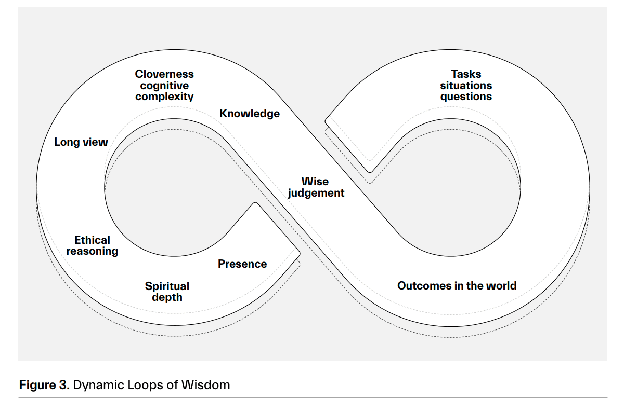
Appendix III: Alexander on the quality without a name
Two passages from Christopher Alexander, in his own words.
From The Timeless Way of Building
The first place I think of, when I try to tell someone about this quality, is a corner of an English country garden, where a peach tree grows against a wall.
The wall runs east to west; the peach tree grows flat against its southern side. The sun shines on the tree and as it warms the bricks behind the tree, the warm bricks themselves warm the peaches on the tree. It has a slightly dozy quality. The tree, carefully tied to grow flat against the wall; warming the bricks; the peaches growing in the sun; the wild grass growing around the roots of the tree, in the angle where the earth and roots and wall all meet.
And so you see, in spite of every effort to give this quality a name, there is no single name which captures it.
Imagine the quality without a name as a point, and each of the words which we have tried as an ellipse. Each ellipse includes this point. But each ellipse also covers many other meanings, which are distant from this point.
Since every word is always an ellipse like this—then every word will always be too broad, too vague, too large in scope to refer only and exactly to the quality which is the point. No word can ever catch the quality without a name because the quality is too particular, and words too broad. And yet it is the most important quality there is, in anyone, or anything.
It is not only simple beauty of form and color. Man can make that without making nature. It is not only fitness to purpose. Man can make that too, without making nature. And it is not only the spiritual quality of beautiful music or of a quiet mosque, that comes from faith. Man can make that too, without making nature.
— Alexander (1979), ch. 2, "The Quality Without a Name"
From The Nature of Order, Book 4: The Luminous Ground
These ultra-mechanistic assumptions about matter — not strictly justified by mechanistic science itself, but inspired by it and encouraged by it — have shaped our attitude to art and architecture and society and environment. They have made good architecture almost impossible.
To keep the text brisk, I have placed discussion of these ten assumptions in the notes at the end of the chapter. That way, a reader to whom these assumptions are already obvious, will not need to struggle through them.
* * *
The first tacit assumption which has crept in is an exaggerated form of an idea that, in a modest form, is essential as a tool in science:
TACIT ASSUMPTION 1. What is true, is only the body of those facts which can be represented as lifeless mechanisms. (Discussion in the note)
A damaging offshoot from assumption # 1 is the widespread and nowadays accepted assumption that value is subjective. This assumption has become nearly the central tenet of modern architecture. Thus:
TACIT ASSUMPTION 2. Matters of value in architecture are subjective. (Discussion in the note)
The pressure to view all matters of value as personal and idiosyncratic has been further intensified as a result of a further assumption something like this:
TACIT ASSUMPTION 3. Modern conceptions of human liberty require that all values be viewed as subjective. The subjective nature of value gives the private striving of each individual person — even when vacuous or image-inspired or greed-inspired — the same weight. Attempts to put value on an objective footing are to be viewed with suspicion. (Discussion in the note)
A further tacit assumption more directly asserts the meaninglessness of the world:
TACIT ASSUMPTION 4. The basic matter of the world is neutral with regard to value. Matter is inert. The universe is made of inert material which blindly follows laws of combination and transformation. (Discussion in the note)
The meaninglessness of the mechanist cosmology we have inherited is further due to the disconnection, within our picture, of what we see as being outside ourselves (the matter which we see as a mechanism) and our experience of what seems to be inside us (which we experience as self). This may be summarized as:
TACIT ASSUMPTION 5. Matter and mind, the objective outer world and the subjective inner world are taken to be two entirely different realms, different in kind, and utterly disconnected. (Discussion in the note)
The disconnection between the outer world of physics, and the inner world of self, finds vivid expression in the strange and nearly meaningless view of art which dominated a considerable part of 20th-century life. This view might be characterized as:
TACIT ASSUMPTION 6. Art is an intense and powerful social phenomenon, but one that has no deep importance in the physical scheme of things, and therefore no basic role in the structure of the universe. (Discussion in the note)
The “lost” role of art comes nowhere into view as strongly, in my mind, as in our perception of the rift between ornament and function in a building. I believe that, without knowing why, 20th-century people learned to subscribe to:
TACIT ASSUMPTION 7. Ornament and function in a building are separate and unrelated categories. (Discussion in the note)
The separated roles given to ornament and function come to a head in a still more “outrageous,” though more veiled, tacit assumption:
TACIT ASSUMPTION 8. At a profound level, architecture is irrelevant. The task of building has no special importance, except in so far as it contributes to practical function through engineering, or to material wealth through image. (Discussion in the note)
The sequence of assumptions approaches its culmination in what is, perhaps, one of the most damaging assumptions of all:
TACIT ASSUMPTION 9. The intuition that something profound is happening in a great work of art is, in scientific terms, meaningless. (Discussion in the note)
And finally one may formulate the following assumption which brings us face to face with the ultimate source of the meaninglessness we experience:
TACIT ASSUMPTION 10. The instinct that there is some kind of deeper meaning in the world is scientifically useless. It has to be ignored as a subject of serious scientific discussion. (Discussion in the note)
I believe these ten assumptions do exist tacitly throughout our everyday lives today. Although thousands of modern books and poems and paintings have helped people assert and affirm their sense of meaning in the world, the world-picture itself, the scientific world-picture, continues to assert the blind meaninglessness of the physical matter in the world, and of the physical matter we ourselves are made of.
— Alexander (2004), Book 4, ch. 1, "Our Present Picture of the Universe", section 7, pp. 19–20
Footnotes
-
See e.g. Barbier et al (2024) ↩
-
See.g. Jeste et al (2019), Dong et. al. (2022) ↩
-
For an account of metacrisis, see Appendix I ↩
-
Common sense has long associated wisdom with a decision-making capacity. Considered by some the initiator of empirical wisdom research, Vivian Clayton noted in the 1970s the tendency of ancient texts to describe the wise as decision-makers; influencing her definition of wisdom as comprised of cognition, reflection, and compassion. ↩
-
Currently in drafting, a second essay on wisdom for a Second Renaissance looks beyond a pragmatic lens to the psycho-spiritual dimensions of wisdom. ↩
-
Part 2 of this series (forthcoming) explores inner and spiritual dimensions of wisdom and wisdom traditions in greater depth. ↩
-
E.g. Pollock & Mulgan (2020) ↩
-
Diagram illustrates a growing gap but does not depict precise trajectories, which are uncertain. Where the curve suggests a slow, gradual increase in wisdom, in reality wisdom might equally be declining - the gap growing even faster. ↩
-
Valueception has roots in the philosophy of Max Scheler, who argued that values are not subjective projections but real, non-material features of a meaning-saturated world, apprehended through feeling and intuition rather than constructed by reason. ↩
-
The triad loosely echoes classical Greek thought, though the fit is imperfect. Sensemaking resembles Aristotle's phronesis (practical wisdom), which deliberates about how to act well; Aristotle held that virtue makes the goal right while phronesis finds the way to it. Valueception is closer to Plato's vision of the Good, or Aristotle's nous, the intuitive grasp of first things (phronesis, he says, needs this "eye of the soul"), than to sophia, his contemplative wisdom of unchanging truths. And will names what fails in akrasia, knowing the good yet not doing it. See Aristotle, Nicomachean Ethics, Books VI–VII; Plato, Republic, Books VI–VII. ↩
-
Sensemaking, by contrast, remains broadly aligned with the rational and empirical priorities of modern thought, though this too possesses an often-de-prioritised intuitive element. See e.g. Davis & Steinbock (2024) ↩
-
Thinkers such as Charles Taylor (1991), Iain Mcgilchrist (2021) and the David Temple group (2023) treat value as an irreducible feature of the cosmos. Their work to restore trust in valueception resonates with the earlier work of e.g. Scheler, for whom values are a priori qualities (e.g. noble, beautiful, holy) grasped through “emotional intuition.” Scheler insists that values are objective strata of being - disclosed rather than invented. Nicolai Hartmann (1932) similarly advocated a hierarchical ontology of values, with normative power (See e.g. Frings (1997 & 2001). Below we’ll introduce the work of a prominent value realist, Christopher Alexander, and its very concrete application in civic planning. ↩
-
In general, this essay is concerned less with claims about whether value is ‘really real’ than correcting the consequences of behaving as if it were not. ↩
-
E.g. as per Mulgan (2021) “The many frameworks and models we have for thinking about a question have to be pitted against each
other to discover which one is most relevant and most coherent…” ↩ -
Importantly, this enquiry isn’t centered on the empirical field of wisdom research. Intuitive knowledge of the measureless is not fundamentally at odds with the scientific method - only with the current assumptions that shape it. In time, scientific axioms may evolve to accommodate insistent realities that are currently denied. ↩
-
Leading empirical accounts of wisdom frequently offer definitions akin to “application of knowledge to life’s challenges.” (Grossman 2017.) We don’t contest this, but rather link the failure of wisdom in globalised modern society with empirically oriented cultures’ radical narrowing of what counts as knowable, and the means by which it is known. ↩
-
The value judgements that guide collective decision-making reflect not necessarily a whole society’s shared views and values, so much as those that have become dominant and thus been encoded in governing institutions. For example, many people living in modern industrialised societies operate a religious world-view regarding knowledge and authority but are governed by institutionalised secular value systems. ↩
-
For extended analysis see Barbier et al. (2024) ↩
-
/Sociologist Georg Simmel (1858–1918) described the central trait of modernism as “the displacement of ends by means”: society gravitates toward challenges that neatly fit its tools. See Simmel (2004 [1900]) ↩
-
E.g. in The Age of Neutralizations and Depoliticizations (1993), Carl Schmitt suggests that modern Europe sought “neutral domains” to escape conflict: from theology to metaphysics/science, then morality, economics and technology. ↩
-
More controversially, Similar intentions can be read into liberal faith in markets and even the design and adoption of neoliberal economics - coordinating economic decisions in a neutral space beyond political disagreement. E.g. in Globalists ((2018), Quinn Slobodian argues that neoliberal thinkers wanted to “insulate” the market away from democratic control. ↩
-
Temple (2023) details a modern tendency to privilege quantitative value alongside “common‑sense sacred axioms” - unchallenged assumptions that certain unmeasurable values - like beauty and goodness, even truth - are real and worthy; assumptions dismantled by post-modernity. As we’ll discuss later, most people still behave as if these values are real - but relativism permeates moral and institutional codes. ↩
-
The contemporary pejorative modern sense of the word subjective takes two related forms: a) subjective values are by nature unsuitable for inclusion in our institutional structures (e.g. our laws and regulations about what can be built), and b) more strongly, they aren't "real" and as such aren't a valid basis for knowledge or action. ↩
-
Rationalism as a paradigmatic modern principle shapes not only collective-decision making, but more fundamentally, the model of human nature that underpins it. Founded on the assumption that humans are ‘homo economicus’, rational maximisers of utility, bureaucratic systems place their trust in calculation: if people are predictable, then complex realities can be governed through metrics, targets, and optimisation. ↩
-
Dougald Hine is among those who argues that modernity tends to “as science to do the work of politics;” substituting human judgement with measurement and calculation; showing up, in times of crisis, as a hope that science will tell us what to do. E.g. Hine (2023) &(2024) ↩
-
See e.g. Kapoor & Debroy (2019) ↩
-
This measure of value is closest to ‘preference’ utilitarianism, where available funds are proxy for capacity to exercise preference. By contrast, ‘hedonistic’ utilitarianism seeks to maximise the experience of happiness or wellbeing. ↩
-
See e.g. Stiglitz (2020) ↩
-
Kasser (2002) Defines intrinsic values in terms of goals such as inner growth and contribution to community ↩
-
E.g. Kasser (2002) ↩
-
E.g. Holmes et al. (2011) ↩
-
E.g. Ian McGilchrist (2023) posits valueception as an innate orientation of living systems, not a recent cultural add-on. ↩
-
E.g. Kahnemann’s Landmark Thinking, Fast and Slow (2011) popularised the dual-system model of cognition. ↩
-
As Hine (2023) points out, While (post-)modern society champions “following the science” our decision-makers rarely just extrapolate from ‘facts’ but continually exercise some kind of judgement, arising at least in part from intuition. ↩
-
Daniel Kahneman (1979) famously debunked the idea of Homo economicus, the rational, self-interested decision-maker, in his work with Amos Tversky on prospect theory. ↩
-
Clayton (1982) has defined wisdom as the ability to grasp human nature - paradoxical, contradictory, and continually evolving; in part addressing extra-rational impulses. ↩
-
See e.g. Bristow et al. (2022) ↩
-
In Scheler’s account of Wertnehmung (“valueception”) value is grasped through essential intuition. (Davis & Steinbock (2024). ↩
-
If this generalisation sounds artificial, consider how much more easily you find your keys when you know they’re here somewhere. ↩
-
Within a broader postmodern suspicion toward universal claims of truth or goodness - see e.g. Foucalt (1980) ↩
-
Stein (2024) 2 highlights ritual practices that “reopen the eye of value”. ↩
-
While indigenous traditions offer many clear examples of applied wisdom, as suggested above, it’s vital to understand how wisdom might be applied within context comparable to modern decision-making. ↩
-
(Alexander 1979) ↩
-
‘without inner contradiction’ (Alexander 1979) ↩
-
“For Alexander, ugliness was not just a lack of beauty but the physical manifestation of disconnection between people, between form and function, between tradition and innovation, between builders and users. In contrast, he argued that beauty is not a matter of taste or cultural convention. It is an objective quality that arises from a structure’s internal coherence and its response to human needs.” Lancaster (2022) ↩
-
Temple (2023) ↩
-
See e.g. Pérez Gómez (1983) pp4. ↩
-
Often supported by consultants with policy backgrounds, monetising their fluency to ‘get around’ vestigial value-preserving regulations to extract maximum profit. ↩
-
Co-authored with Sara Ishikawa and Murray Silverstein ↩
-
Hartmann distinguished also value itself - ideal and timeless - from ‘goods’ - the concrete, bearers of value. See e.g. Frings (2001) ↩
-
William James’s pragmatic method treats belief and reality as a lived enquiry. In Pragmatism (1907), he writes: “The true is the name of whatever proves itself to be good in the way of belief, and good, too, for definite, assignable reasons.” Ontological commitments aside, both Rob Burbea and Iain McGilchrist espouse this kind of pragmatism regarding non-material qualities and values, at the level of spiritual practice and society respectively. ↩
-
Lancaster (2025) ↩
-
We’ll return to how such a quality might be identified, and by who, presently. ↩
-
Alexander (1979) p570 ↩
-
Conversely, individuals could potentially attain high degrees of wisdom regarding their own inner world or the nature of consciousness, but remain naïve when it comes to the needs of the group, and what it takes to translate choices into wise collective action. ↩
-
Geoff Mulgan’s ‘Loop Theory’ models societal wisdom as a compound, contextualised dynamic - serial ‘loops’ of thinking and acting wherein knowledge of context gives rise to relevant decision making, identified in retrospect by good outcomes, feeding back into collective knowledge. “integrative wisdom and intelligence are grown through loops of thought involving arguments within our heads, that lead to judgements, which are then improved through reflection on what actually happens, the feedback we get from the world.” See Mulgan (2021) ↩
-
Naive intuitionism is the view that we can simply and reliably grasp values through immediate emotional intuition. The phrase was coined by Nicolai Hartmann, critiquing Scheler’s ethics of value-intuition. (See e.g. Frings (1997 & 2001). ↩
-
E.g. Bristow et. al (2022), Assor et al. (2023) ↩
-
Gendlin (1981), Levine (2010) ↩
-
Philosophers from Kant to Habermas have distinguished formal, a priori logic from more fully dimensional reason, integrating e.g. moral and contextual values. ↩
-
In recent years, Republican leaders have taken advantage of periods of political control to appoint large numbers of judges whose lifetime tenure will shape U.S. law for decades to come. ↩
-
Andersen & Björkman (2017) suggest that the strength and resilience of Nordic social democracies rest in part on this integrated effort to cultivate inner capacities at a population level. ↩
-
See e.g. Deneen (2018). ↩